


Matthew Shepard


Matthew Wayne Shepard was born on December 1, 1976 in Casper, Wyoming, the first son of Dennis and Judy Shepard. His father worked in the oil industry and his mother was a community activist. He was raised in the Episcopal Church and spent his early childhood in Wyoming before the family moved when Dennis accepted a position with Saudi Aramco. The Shepards relocated to Dhahran, Saudi Arabia, where Matthew attended an international school before completing his secondary education at The American School in Switzerland, known as TASIS. He graduated in 1995. Friends and teachers later remembered him as sensitive, gentle, and interested in politics and global affairs.

During a senior trip to Morocco he suffered a violent assault in Marrakesh, an experience that affected him deeply and led to struggles with depression and anxiety. After returning to the United States he enrolled first at Catawba College in North Carolina, later attending Casper College in Wyoming. He spent time in Colorado and ultimately enrolled at the University of Wyoming in Laramie. There he studied political science and became active in campus organizations, including the LGBTQ student group. Openly gay at a time when visibility still carried significant personal risk, he spoke of one day working in diplomacy or human rights advocacy.
On the night of October 6, 1998 he went to the Fireside Lounge in Laramie. There he encountered two local men, Aaron McKinney and Russell Henderson, who claimed they were acting friendly and offered him a ride. Once in their truck they robbed him and drove him to a remote fence line outside the city. He was beaten severely, tied to the fence, and left exposed through the cold Wyoming night. A cyclist discovered him the following afternoon, at first mistaking him for a scarecrow until seeing movement. He was transported to Poudre Valley Hospital in Fort Collins, Colorado, where he remained in a coma. On October 12, 1998 Matthew Shepard died from his injuries at twenty-one years old.

The crime drew national and international attention. Candlelight vigils were held across the United States and abroad. His parents, Judy and Dennis Shepard, became prominent voices calling for stronger protections against hate-motivated violence. In the aftermath they established the Matthew Shepard Foundation to promote LGBTQ+ equality, inclusion, and safety.
The trials of his killers took place in 1999 in Laramie. Russell Henderson pleaded guilty to avoid the death penalty and received two consecutive life sentences. Aaron McKinney went to trial, was convicted of felony murder, and also received two consecutive life sentences without possibility of parole after the Shepard family requested that the death penalty not be pursued.

His death inspired numerous cultural works including The Laramie Project, which premiered in 2000 and brought wider attention to the circumstances of the crime and the community’s response. Over the following years Matthew Shepard’s name became synonymous with the fight against hate crimes in the United States.
On October 28, 2009 President Barack Obama signed the Matthew Shepard and James Byrd Jr. Hate Crimes Prevention Act into law, expanding federal hate crime statutes to include protections based on sexual orientation and gender identity.
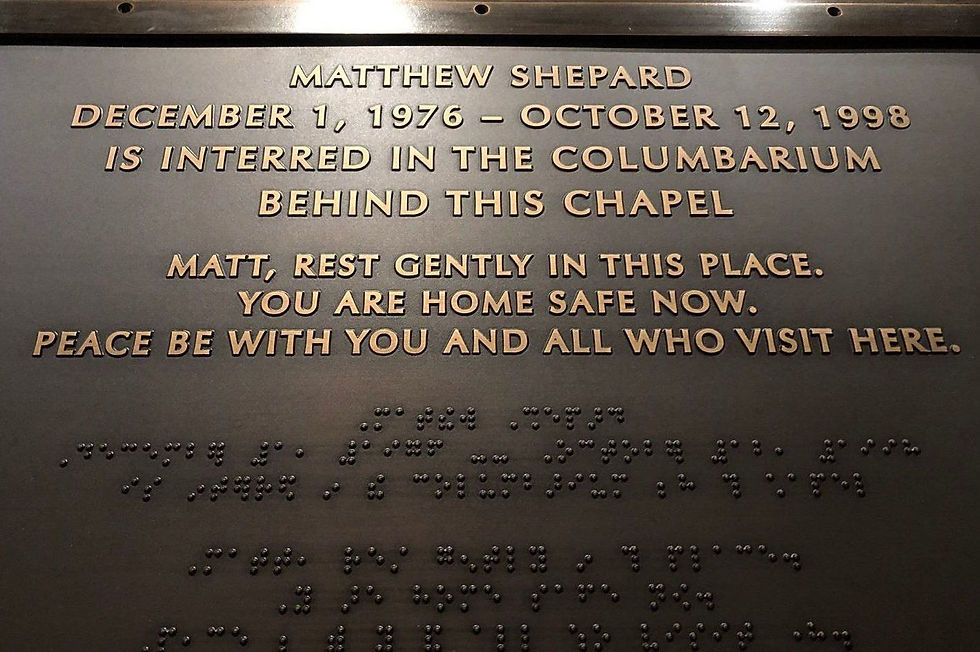
For many years after his death his ashes remained with his parents, who were reluctant to choose a final resting place out of concern that it might be vandalized by those who still harbored hatred. In 2018, twenty years after his murder, it was announced that his cremains would be interred at Washington National Cathedral in the District of Columbia. On October 26, 2018 a public service was held there, presided over by Episcopal bishops and attended by mourners from across the country. His ashes were laid to rest in the cathedral’s columbarium, giving him a permanent and protected resting place in a sacred national setting.



Comments