


The Legacy of Clarendon Court


Claradon Court was built on Bellevue Avenue in Newport between 1903 and 1904 for Edward Collings Knight Jr., a Philadelphia native who had been part of Newport’s summer colony for more than thirty years. Born in Philadelphia on December 14, 1863, he was the son of Edward Collings Knight Sr. and Anna Maria McGill Knight.

He pursued a business career that combined interests in sugar manufacturing and railroads, and for many years was associated with the Pennsylvania Railroad, from which he later retired. By the turn of the twentieth century, Knight had established himself as a seasonal resident of Newport and a participant in its social life, holding memberships in the Reading Room and the Clambake Club.
The house was designed by Horace Trumbauer and closely followed an early eighteenth century English design by Colen Campbell.
From the outset, it was conceived as a formal summer residence that reflected established taste and permanence rather than architectural display.

The house was originally known as Claradon Court. Named for his wife and daughter, it was constructed on Bellevue Avenue near Beaulieu, an established neighboring estate that predated it by several decades. At the time of its construction, the surrounding properties reflected an earlier phase of development along the avenue, before the later expansion of large twentieth century houses to the south.

Knight occupied Claradon Court during the Newport seasons with his wife, Clara Waterman Dwight, whom he married on June 3, 1886. Clara was the daughter of Edward Parsons Dwight of Philadelphia and the granddaughter of Isaac S. Waterman, a Philadelphia merchant and financier. The couple divided their year between Newport and New York, maintaining Claradon Court as their summer home while spending winters in the city. Clara died in January 1910 at the Plaza Hotel in New York.

In 1922, he married his second wife, Marie Louise Joséphine LeBel. In 1928 Knight commissioned a smaller and less formal residence known as Stonybrook, designed by Horace Trumbauer.
As Stonybrook became his primary residence, Claradon Court was no longer central to his household. In the summer of 1929, Knight sold the Bellevue Avenue property to Harry St. Francis Black.


Claradon Court entered a brief transitional period under Harry St. Francis Black. Born in Cobourg, Ontario, on August 25, 1863, Black was the son of Thomas Black, a British army officer, and Elizabeth Wickens Black. He came to the United States at a young age and built a formidable financial career, beginning with engineering and surveying work in the American West before entering banking in Washington State during the 1880s.
By the close of the nineteenth century, Black had become closely associated with the George A. Fuller Company, one of the most influential construction and real estate firms of its era. He rose to the presidency of the company following the death of its founder in 1900 and later became chairman of the board of the United States Realty and Improvement Company after a major corporate merger. His professional life placed him at the center of large-scale development in New York and beyond, including involvement in prominent hotels, railroads, and financial institutions. Black maintained his primary residence in New York City, occupying an apartment at the Plaza Hotel, and was widely connected in social and business circles through his club affiliations in New York, Washington, Chicago, and Paris.
Although well known among Newport’s summer residents, Black did not establish Claradon Court as a personal residence. Contemporary accounts indicate that the house had been rented prior to his purchase and continued to be rented afterward, with Black never intending to occupy it himself. His ownership of the Bellevue Avenue property was brief and largely administrative.
Harry St. Francis Black died on July 19, 1930, at his summer residence known as Allondale in Huntington, Long Island. Following his death, Claradon Court was sold later that year by his widow to Mrs. William Hayward.

Claradon Court entered a period of renewed residential use following its sale late in 1930 to William Hayward and his wife, Sarah Mae Cadwell. Mae Cadwell had been born in Wethersfield, Connecticut, on October 16, 1880, the daughter of Martin Cadwell and Rowena Morgan Cadwell, and had moved within prominent social and financial circles from an early age. Before her marriage to Hayward, she had been widowed twice, first from Selden Bailey Manwaring and later from Morton Freeman Plant, one of the principal figures of New York finance. These marriages placed her firmly within the world of wealth and influence that shaped Newport society in the early twentieth century.

William Hayward, born in Nebraska City in 1877, was a lawyer whose career took him from the Midwest to New York, where he became deeply involved in public service and military leadership. During the First World War, he commanded the 369th Infantry Regiment of the New York National Guard, later known as the Harlem Hellfighters, leading the unit through extended combat service in France. After the war, Hayward continued his legal career in New York, serving as United States Attorney for the Southern District of New York and later returning to private practice.
With the purchase of Claradon Court, the Haywards brought the house back into active seasonal use. Under their ownership, the name was altered from Claradon Court to Clarendon Court, the form by which it would thereafter be known. The estate once again functioned as a Newport summer residence.
William Hayward died in 1944, leaving Mae as the surviving owner of Clarendon Court. She continued her association with Newport after his death, maintaining the house as part of her seasonal life. In 1945, she married John Edward Rovensky, an international banker and industrial executive.

Rovensky had been born in New Glasgow, Nova Scotia, in 1880 and moved to Pittsburgh as a child. He built a long financial career that began in banking and expanded into international finance and industry.
By the middle of the twentieth century, he had served as a senior executive with major banking institutions and later became associated with American Car and Foundry, where he played a role in large scale industrial management during the postwar years.
Rovensky maintained a seasonal life divided between Palm Beach, New York, and Newport, and was a longtime member of Newport social institutions including the Reading Room, Bailey’s Beach, and the Newport Country Club.
Mae Cadwell Hayward Rovensky died in Newport in 1956. After her death, Clarendon Court passed out of the immediate continuity that had linked it to the Hayward household. Rovensky survived her by more than a decade and died in 1970. Within a short time of his death, the Bellevue Avenue house would pass into new ownership, opening the most publicly scrutinized chapter in its history.

Clarendon Court entered its most publicly documented and consequential period in 1970, when it was purchased by Martha Sharp Crawford von Bülow, known as Sunny, for $250,000. With her husband, Claus von Bülow, she brought the house back into full residential use after years of relative quiet. Early in their ownership, Sunny undertook substantial work on the property, investing approximately $600,000 in restoration and modernization. These improvements included updated mechanical systems, security, landscaping, and interior work intended to preserve the house while adapting it to contemporary living.

Throughout the 1970s, Clarendon Court functioned as the von Bülows’ Newport residence. The house was used for formal entertaining and family life and remained private, though its occupants were well known within Newport society.

In 1979, Sunny von Bülow suffered a medical emergency at Clarendon Court, from which she recovered. A second and far more serious incident occurred in December 1980, when she was found unconscious on the bathroom floor of the house. She never regained consciousness and remained in a coma for the rest of her life.
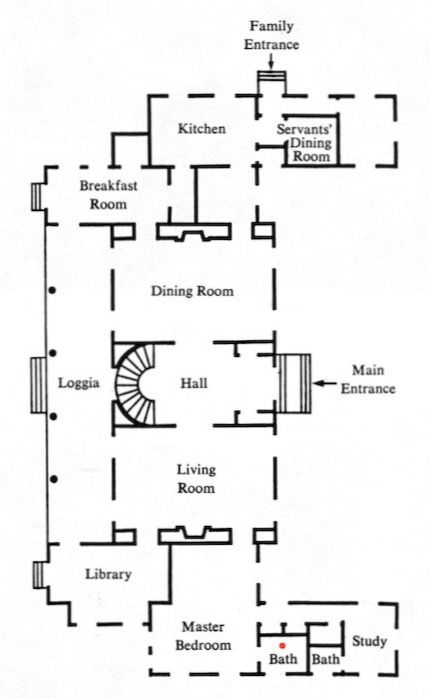
What followed was a prolonged legal and personal unraveling that permanently altered the house’s place in public consciousness. Criminal charges were brought against Claus von Bülow, leading to a trial that resulted in conviction, later overturned on appeal. A second trial ended in acquittal in 1985. During these years, the house stood as a silent witness to events that drew international attention, though it itself remained physically unchanged.

In December 1985, Claus and Sunny von Bülow were divorced. As part of the settlement, Claus von Bülow relinquished all claims to Sunny’s fortune and ceased living at Clarendon Court. Legal control of the property rested thereafter with Sunny’s interests under court supervision, as she remained incapacitated and institutionalized in New York. From that point forward, Clarendon Court was no longer occupied as a family home.
By 1988, the decision was made to sell the estate. The sale required judicial approval and followed a period during which the property was marketed at varying asking prices. That year, Clarendon Court was sold for $4.25 million, formally closing the von Bülow chapter.

Following its court approved sale in 1988, Clarendon Court entered a period of renewed privacy. The house was purchased for $4.25 million by Glenn Randall, a Washington art dealer and longtime Newport summer resident. After years of public scrutiny during the von Bülow era, the property returned to use as a private residence, and the intense attention that had surrounded it quietly receded.

In the years that followed, Clarendon Court remained intact as a single family estate. Unlike many of Newport’s great houses that were converted to institutional use or opened to the public, it continued to serve the residential purpose for which it had been built. The house passed through subsequent private ownership without controversy, its architectural character preserved and its role within the Bellevue Avenue landscape unchanged.

In 2021, Clarendon Court was sold again, this time for approximately $30 million, one of the highest residential prices recorded in Rhode Island. The sale reflected both the renewed market for Newport’s historic estates and the enduring appeal of Clarendon Court as a private home rather than a museum or commercial property.

Today, Clarendon Court remains privately owned, standing as a rare example of a Bellevue Avenue house that has passed through more than a century of changing fortunes while continuing to be lived in as a residence, its story shaped by the lives that passed through it rather than by public display.


Special Note: My sincere thanks go to those who so generously shared their time, knowledge, and images in support of this work. I am deeply grateful to Gary Lawrence of Mansions of the Gilded Age, the Newport Historical Society, the historians behind Newport Lost and Found, James Michael, and Mike Franco. I also extend special thanks to Bettie Bearden Pardee of Private Newport and to Vibrant Optics, whose photography and collaboration were invaluable. Their collective generosity made it possible to tell the story of Clarendon Court.


Comments