


Alexander Turney Stewart
- Bobby Kelley
- Apr 13
- 4 min read


Alexander Turney Stewart
October 12, 1803 – April 10, 1876
Alexander Turney Stewart was born on October 12, 1803, in Lisburn, Ireland, to Scottish Protestant parents. His father died only weeks after his birth, and soon after, his mother left for America with her new husband. Stewart remained behind, raised by his grandfather, who intended for him to enter the ministry. His early education was strict and deliberate, but his path changed after his grandfather’s death. He was taken in by an Irish Quaker family and introduced to practical business life. By his mid-teens, Stewart had abandoned religious ambitions and turned toward commerce.
In 1818, at fifteen years old, he sailed to New York with five hundred dollars he had earned as a grocer. He began modestly, working as a teacher for a salary of three hundred dollars a year. It was steady work, but not the future he wanted. By the 1820s, Stewart entered the dry goods trade, opening a small shop on Broadway. What followed was one of the most remarkable business rises in American history.
The Empire
Stewart did not simply run a store. He reinvented how people shopped. He introduced fixed pricing at a time when haggling was the norm. Customers were treated with consistency, not negotiation. He focused on high quality goods, imported fabrics, and a level of presentation that turned retail into an experience. His first major expansion came with the construction of his “Marble Palace” on Broadway in 1848, a striking white building that drew attention as much for its appearance as for its contents. It was one of the first true department stores in the United States.
From there, his empire expanded rapidly.

By the 1860s, Stewart constructed an even larger retail complex known as the “Iron Palace,” a vast cast iron structure that occupied an entire city block. Inside were multiple floors of goods, organized and displayed in a way that had never been seen before. Customers came not just to buy, but to see. At its height, Stewart’s business employed thousands and generated immense wealth. He controlled supply chains, imported goods directly, and operated with a scale that rivaled entire industries. He was widely considered the richest merchant in America.
His success extended beyond retail. On Long Island, he developed Garden City, an ambitious planned community complete with wide avenues, housing, and a grand cathedral intended to serve as both a place of worship and a lasting monument.
The Mansion
In New York City, Stewart built a residence that reflected his wealth and status. His mansion on Fifth Avenue was constructed of white marble and stood as one of the most impressive private homes in the city. Inside, it was filled with fine furnishings, imported materials, and carefully curated rooms designed to display both taste and power. It was within this house that he lived out his final years.
Death and Burial
Alexander Turney Stewart died on April 10, 1876, within his Fifth Avenue mansion.
His death was treated with the same attention to detail that had defined his life. His body was placed on ice within the home. A death photograph was taken, and a plaster cast of his face was made.
He was enclosed within three coffins, an inner oak shell covered in black velvet, sealed within lead, and placed inside an outer cedar case. His funeral drew great attention. The casket was displayed within the mansion before being transported by hearse to St. Mark’s Church in New York City. There, beneath a simple marble slab, he was placed within a concealed underground vault. The entrance was sealed, covered with earth, and carefully hidden from view. For more than two years, he remained undisturbed.
The Warning
In September 1878, an anonymous letter warned that an attempt would be made to steal Stewart’s body.
The warning was largely dismissed. Weeks later, the grave showed signs of disturbance. The stone appeared to have been shifted and replaced. In response, new locks were installed, and the position of the grave marker was altered to conceal the vault’s exact location. A watchman was assigned to patrol the grounds. For a time, nothing happened. Then the watchman was dismissed.
The Theft
Three days later, the vault was broken open. On the morning of November 7, 1878, fresh earth revealed what had been done. Inside the tomb, the coffins had been forced apart. The silver plate was gone. A piece of velvet had been cut from the inner lining. The body of Alexander Turney Stewart had been taken. There were no obvious signs of entry. Whoever carried out the crime had precise knowledge of the vault’s location and construction. A reward of twenty five thousand dollars was offered.
No one came forward.
The Ransom
Months later, a letter arrived from a man calling himself Henry G. Romaine.
He claimed to possess the body and demanded two hundred thousand dollars for its return.
To prove his claim, he provided details known only to the thieves and produced a piece of the coffin’s velvet lining. Negotiations began through coded messages placed in newspaper personals. The demand was refused. Time passed. Years later, the price dropped. Stewart’s widow, exhausted by grief, was willing to pay. After further negotiation, the amount was reduced to twenty thousand dollars.
The Exchange
The terms required absolute secrecy. A single messenger would carry the money out of New York at night, alone, following a route provided by the thieves. If he was followed, the exchange would not occur. In the early hours of the morning, along a deserted road, masked men approached. Passwords were exchanged. The velvet fragment was matched. The money was handed over. The remains of Alexander Turney Stewart were returned.
Final Rest
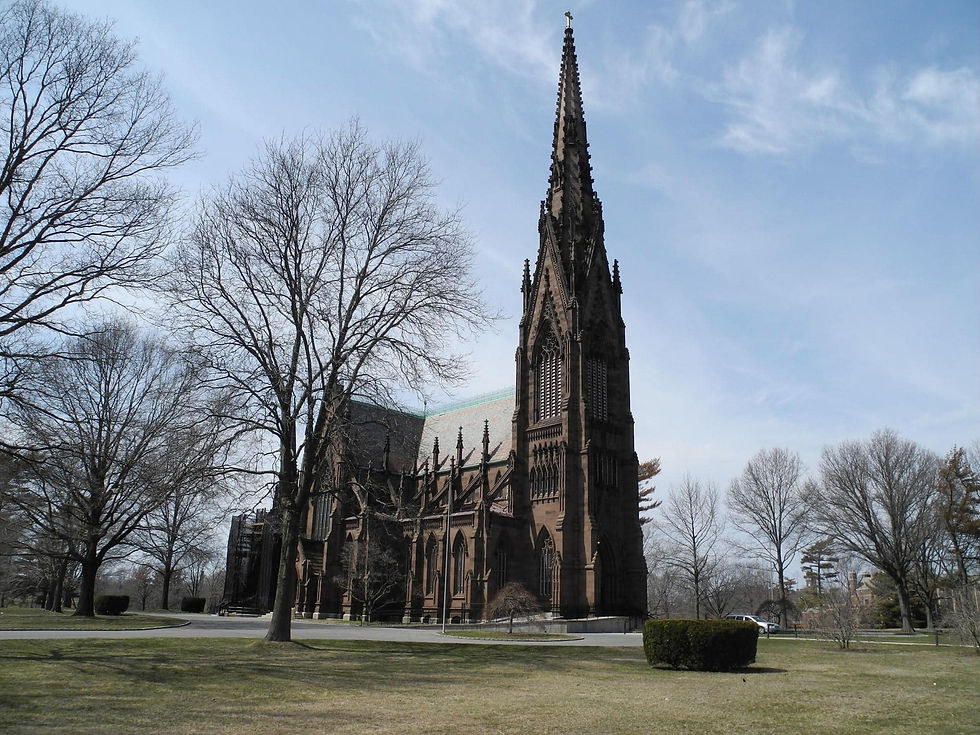


The return was quiet and without ceremony. Within a day, the body was taken to the Cathedral of the Incarnation in Garden City, the great church Stewart’s widow had built in his memory. There, within a concealed crypt, he was laid to rest once more. When Cornelia Mitchell Clinch Stewart died in 1886, she was placed beside him. Their exact resting place remains hidden within the cathedral. No visible tomb marks the spot, only a massive stone vessel & plaque bearing their names. For a time, one of the richest men in American history could not rest in peace. In the end, he was brought back, and finally left undisturbed.


So interesting to read about this man! Amazed at the immense size of his building and the wealth he had, however, finding a resting place for him was certainly a huge task.
Wild story about a man who was so successful that he didn't have enough mansion wall space for his fine paintings so had to lean them against his private collection of marble statues. Thanks for another great profile!