


Sir Harry Oakes, Baronet of Nassau

Updated: May 19

Sir Harry Oakes, 1st Baronet, was born Harry Oakes on December 23, 1874, in Sangerville, Piscataquis County, Maine, the son of William Pitt Oakes and Edith Nancy Lewis Oakes. He was born into a long-established New England family whose roots in central Maine stretched back generations, but his own ambitions carried him far beyond the forests and farming communities of Piscataquis County. Through persistence, instinct, and an extraordinary willingness to endure hardship, he rose from modest beginnings to become one of the richest mining men in the British Empire, a major benefactor in Canada and the Bahamas, and ultimately the central figure in one of the twentieth century’s most notorious unsolved murders.
During Harry’s youth, the Oakes family moved from Sangerville to nearby Foxcroft so the children could receive better educational opportunities. He attended Foxcroft Academy, where he developed a reputation for intelligence, independence, and ambition. Even in his early years, acquaintances later recalled that Oakes possessed unusual confidence in his future success. After completing his studies in Maine, he attended Bowdoin College, earning a Bachelor of Arts degree before briefly considering a more traditional professional career. Yet the restless energy that defined his life soon drove him away from stability and toward the uncertain world of prospecting and mining.
By the late nineteenth century, gold rushes and mining booms had transformed large portions of North America and the wider world. Young men traveled across continents searching for mineral wealth, and Harry Oakes became one of them. For years he wandered from mining district to mining district, enduring repeated disappointment while slowly developing the skills that would eventually make him enormously successful. He prospected in the Yukon during the declining years of the Klondike Gold Rush, worked in Alaska, traveled through the American West, and searched for opportunity in Australia, New Zealand, Africa, Mexico, and other frontier regions associated with mining speculation.
These years were marked far more by hardship than by success. Oakes labored in extreme climates, survived periods of poverty, and frequently found himself far from civilization with little certainty about the future. In the far north he experienced brutal winter temperatures and the physical dangers of frontier camps. In other regions he endured exhausting travel, failed claims, illness, and financial reversals. Yet these experiences also gave him an education impossible to obtain in a classroom. He learned geology through observation and practice, developing an unusual ability to recognize promising mineral formations and understand ore structures that other prospectors often ignored.
His years in Australia proved particularly important because he encountered telluride ore formations associated with volcanic rock systems. The knowledge he gained there remained with him long afterward and later influenced the decisions that changed his life. Unlike many prospectors who relied almost entirely upon luck, Oakes increasingly approached mining with careful attention to geological patterns and long-term potential.

In 1911, Harry Oakes arrived in northern Ontario during the early development of the Kirkland Lake mining district. At that time the region remained isolated and rugged, populated by prospectors, laborers, and speculators drawn by rumors of gold discoveries. Small settlements such as Swastika and Kirkland Lake were rough frontier communities surrounded by forests, rock outcroppings, primitive roads, and newly opened claims.
According to longstanding accounts associated with the district, Oakes learned of promising open ground while staying in Swastika, Ontario. He partnered with several prospectors, including members of the Tough family, and together they secured claims during severe winter weather in what became known as the Tough-Oakes property. The district rapidly attracted attention as additional discoveries confirmed the extraordinary richness of the area.
Oakes recognized geological similarities between the Kirkland Lake formations and mining districts he had studied elsewhere in the world. While some early prospectors dismissed portions of the ore as unpromising, Oakes believed the system extended far deeper and possessed exceptional value. His judgment proved correct. The property that evolved into the Lake Shore Mine became one of the richest and most productive gold mines in Canadian history.
The success of the Lake Shore Mine transformed Harry Oakes almost overnight. By the 1920s he had become one of the wealthiest men in Canada, earning immense profits from mining operations, investments, and associated business ventures. The Lake Shore Mine ultimately produced millions of ounces of gold and stood among the great mining enterprises of the twentieth century. Newspapers and magazines increasingly portrayed Oakes as the classic self-made mining millionaire, a man who had spent years wandering the globe in poverty before discovering one of the greatest gold deposits in North America.
Despite his wealth, Oakes retained many of the blunt traits formed during his years as a prospector. Contemporary observers often described him as fiercely independent, stubborn, practical, and suspicious of authority. He disliked unnecessary formality and possessed little patience for social pretension. Although he eventually entered elite financial and political circles, he never entirely abandoned the frontier mentality that had shaped him during decades of hardship and uncertainty.

Following his financial success, Oakes embarked upon a world cruise during which he met Eunice Myrtle MacIntyre, a young Canadian woman from Ontario. The two married in 1923 despite a significant difference in age. Their union attracted attention because of Oakes’ growing fortune and public reputation, but the marriage endured for decades and produced five children. Their family life unfolded amid extraordinary wealth, international travel, and increasing public visibility.
Around this same period, Oakes renounced his American citizenship and became a naturalized Canadian citizen, reflecting the reality that his fortune and business interests had become closely tied to Canada. Yet even as his wealth expanded, he became increasingly concerned about taxation and financial regulation. Seeking a favorable environment for both investment and residence, Oakes eventually turned his attention toward the Bahamas.
When Harry Oakes relocated to Nassau during the 1930s, the Bahamas remained a British colony with limited infrastructure and widespread economic inequality. Wealthy expatriates and foreign investors played an increasingly important role in the colony’s economy, and Oakes quickly emerged as one of the most influential individuals in Nassau. Rather than merely purchasing a winter residence, he invested heavily in development projects, utilities, transportation systems, land, and tourism-related enterprises.

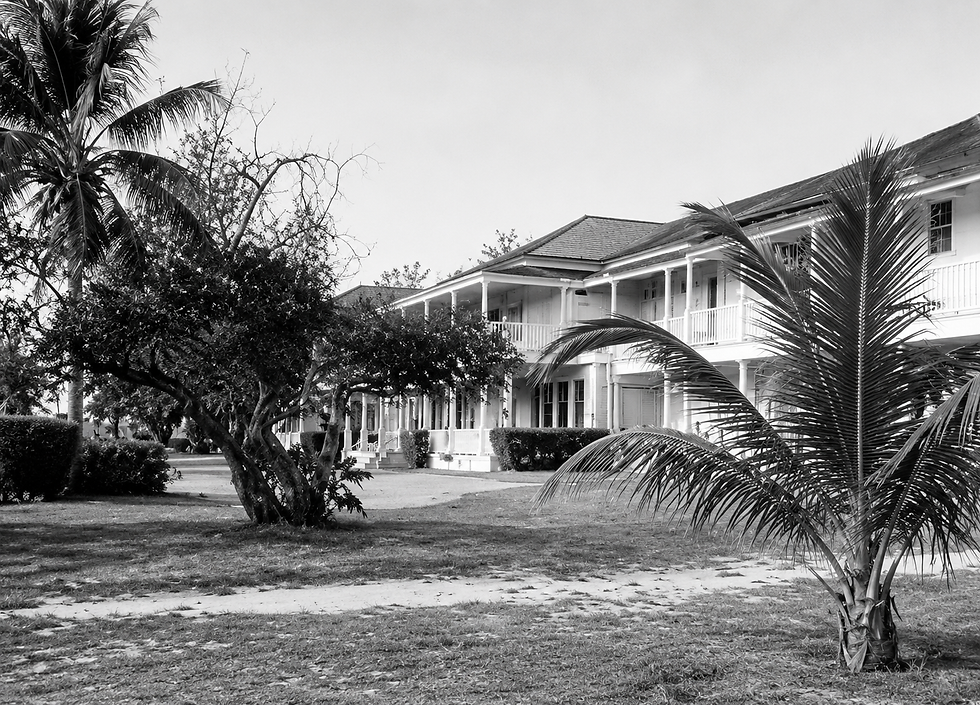
Oakes financed roads, public improvements, aviation initiatives, and infrastructure projects while contributing substantial sums to charitable causes. He supported medical programs, child welfare initiatives, educational efforts, and wartime charities. Among his projects were transportation services and public welfare programs intended to improve conditions within the colony. Though his methods could be highly personal and independent of government bureaucracy, many Bahamians regarded him as an important benefactor whose investments brought employment and modernization during difficult economic years.

His influence extended beyond the Bahamas. In Niagara Falls, Ontario, Oakes constructed the grand estate known as Oak Hall and contributed significantly to civic beautification projects associated with the Niagara Parks system. Oakes Garden Theatre, overlooking the falls, became one of the best-known public spaces associated with his philanthropy and wealth. Through these projects, Oakes established himself not merely as a mining magnate but as a major public figure whose fortune shaped communities in both Canada and the Caribbean.
In recognition of his philanthropic and public contributions, King George VI created him a baronet in 1939, formally granting him the title Sir Harry Oakes, 1st Baronet. The honor elevated him into the titled ranks of British society, though his personality remained far closer to that of a hard-driving mining man than a conventional aristocrat.
The outbreak of the Second World War transformed life throughout the British Empire, including the Bahamas. Nassau gained increased strategic significance because of its location in the Atlantic and Caribbean. Wartime financial restrictions, political tensions, and international concerns brought new pressures upon the colony and its wealthy residents. During this same period, the former King Edward VIII, now the Duke of Windsor after his abdication from the British throne, arrived in Nassau as Governor of the Bahamas.

The Duke and Duchess of Windsor became central figures within Nassau society and interacted regularly with wealthy expatriates, including the Oakes family. Their later association with the aftermath of Harry Oakes’ murder would contribute greatly to the enduring controversy surrounding the case.

Meanwhile, tensions had developed within the Oakes family itself. Oakes’ eldest daughter, Nancy Oakes, fell in love with Alfred de Marigny, a charismatic and controversial figure whose background and social reputation deeply troubled Nassau’s elite circles. Harry Oakes strongly opposed the relationship and distrusted de Marigny, but Nancy nevertheless married him in 1942 shortly after reaching adulthood. The marriage generated considerable local gossip and intensified already strained family dynamics.

During the night of July 7 and the early morning hours of July 8, 1943, Sir Harry Oakes was attacked inside his bedroom at Westbourne, his Nassau estate. He suffered fatal injuries to the head, and the room was partially burned afterward in what investigators believed may have been an attempt to obscure the circumstances of the crime. The murder of one of the richest men in the British Empire immediately became international news.
Responsibility for the investigation quickly became controversial. The Duke of Windsor took an unusually active role in the aftermath of the murder, bringing in outside investigators and helping oversee aspects of the inquiry. Critics later argued that political pressure, procedural failures, and mishandled evidence compromised the case from the beginning.
Suspicion rapidly focused upon Alfred de Marigny because of his difficult relationship with Harry Oakes and his outsider status within Nassau society. De Marigny was arrested and charged with murder. The prosecution’s case relied heavily upon fingerprint evidence that allegedly linked him to the crime scene, but the defense forcefully attacked both the handling of evidence and the overall competence of the investigation.
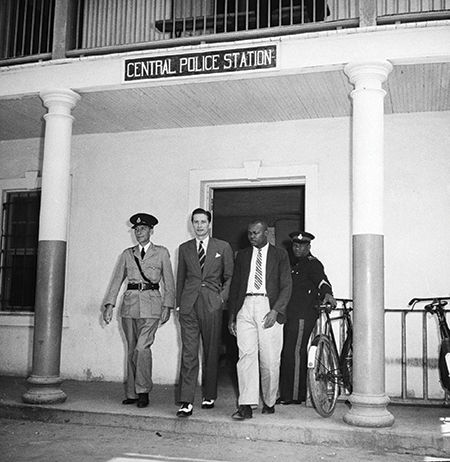
The trial became one of the most famous criminal proceedings in Bahamian history, attracting enormous press attention throughout the United States, Canada, and Britain. Journalists portrayed Nassau as a colony filled with wealth, gossip, political intrigue, and hidden rivalries beneath its glamorous tropical image. After hearing the evidence, the jury acquitted Alfred de Marigny following a comparatively brief deliberation.
No one was ever convicted of murdering Sir Harry Oakes.
In the decades that followed, countless theories emerged regarding the crime. Some writers and investigators suggested possible involvement by business associates, political interests, organized criminal elements, or individuals connected to wartime financial operations. Others focused upon Harold Christie, a close friend and associate of Oakes who became one of the most debated figures connected to the case. Various allegations involving missing witnesses, smuggling operations, and political interference circulated widely over the years, though many remained speculative and unproven. The murder ultimately entered the realm of historical mystery, with competing interpretations continuing long after the original investigation ended.
At the time of his death, Harry Oakes possessed a fortune worth many millions of dollars and stood among the most prominent mining figures of his generation. Yet the sensational nature of his murder eventually overshadowed much of the extraordinary story that had preceded it. His life had encompassed the final age of frontier prospecting, the rise of industrial gold mining, the growth of international tourism in the Caribbean, and the social world of wealthy expatriates within the late British Empire.
Following funeral services and international press coverage, his body was returned to Maine. Sir Harry Oakes was entombed in the Oakes Family Mausoleum at Dover Cemetery in Dover-Foxcroft, Piscataquis County, Maine, not far from the communities where his remarkable journey had begun.


Comments