


Frank Phillips, The History of Phillips 66 & Woolaroc.


Frank Freeman Phillips was born on November 28, 1873, near Scotia, Nebraska, the eldest son of Lewis Franklin Phillips and Lucinda Josephine Faucett Phillips. When he was still an infant, his parents left Nebraska after drought and grasshoppers ruined their crops and settled on a small farm near Conway, Iowa. Life on the Iowa farm was hard, and from an early age Frank learned the meaning of work. He earned his first wages digging potatoes for ten cents a day and began to understand that the security of a family depended on steady effort and a willingness to take chances when opportunities came.
By his early teens, Frank had left school and taken a job as an apprentice in a barber shop in Creston, Iowa. He liked the dignity of the trade, the clean white towels, the polished shoes, and the steady stream of customers who brought in stories from the wider world. He discovered that the barber chair was also a place where businessmen talked freely about money and opportunity. Before long he was working long hours, learning how to handle customers and how to run a shop of his own. In time he owned several barber shops in Creston and created and sold a hair tonic he called Mountain Sage. These small enterprises gave him his first taste of risk and reward and brought him into contact with the town’s bankers and business leaders.
Among those men was John Gibson, a respected local banker. Over time Frank not only gained Gibson’s confidence as a young businessman but also fell in love with his daughter, Jane Gibson.

Frank and Jane were married on February 18, 1897, at the Methodist Episcopal Church in Creston. After their marriage, Frank made a serious change in direction, leaving the barber trade to join his father in law’s bond and banking business. Through that work he learned to read balance sheets, sell securities, and evaluate whether a venture was worth the risk.

Their only son, John Gibson Phillips, was born the following year, and for a time it seemed that Frank’s future would lie entirely in midwestern banking and bonds.
During a trip to the Louisiana Purchase Exposition in St. Louis in 1903, Frank heard stories about the new oil fields opening up in Indian Territory. Men were talking about shallow wells, cheap leases, and fortunes made quickly, but they also spoke about dry holes, borrowed money, and outfits that folded as fast as they had appeared. Those conversations stirred something in him. He had already learned to shift from one line of work to another, and he could see that oil might offer more than anything bonds could provide.
By 1905 Frank, Jane, and their young son had moved to Bartlesville in Indian Territory. Together with his younger brother, Lee Eldas, known as L. E., Frank began to buy leases and organize a small drilling venture. The brothers formed early companies that included Anchor Oil and Gas and Lewcinda Oil Company, named from a combination of their mother’s and Jane’s names. The work was risky from the start. Their first wildcat well, the Holland No. 1, came in, but two of their next wells were dry. Each dry hole meant borrowed money to pay drillers and crew, and after those failures they had only enough capital left to try one more time.

That last chance was the Anna Anderson No. 1 well, located just north of Bartlesville. When it finally came in on September 6, 1905, it was a true gusher. The success of Anna Anderson No. 1 not only saved the brothers from financial ruin, it changed the course of their lives. Investors who had been doubtful now saw proof in flowing oil, and the brothers were able to raise new capital through the sale of stock. The well became the first in a remarkable string of producing wells that gave the Phillips interests a reputation for steady success in the field. At a time when much natural gas was simply burned off as waste, the Phillips brothers began to pay attention to its potential and helped pioneer ways to capture and profit from it.
In late 1905 Frank and L. E. organized Citizens Bank and Trust in Bartlesville, then acquired Bartlesville National Bank and combined the two under the Bartlesville National name. For a few years they balanced banking with oil, building both ventures side by side as Bartlesville began to grow.
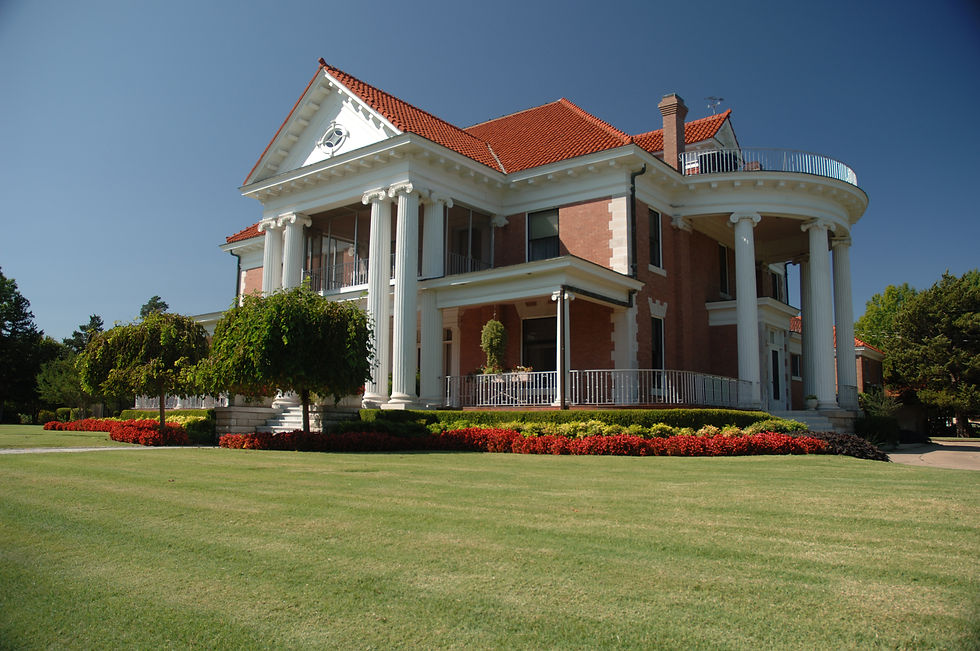
In 1909 Frank and Jane built an impressive twenty six room mansion at 1107 South Cherokee Avenue in Bartlesville. The house was designed in the Neo Classical style with tall white columns, carved wood, and richly furnished rooms that reflected their growing success. It was a home where business and hospitality often blended, and guests from across the region were welcomed there for meetings, dinners, and social occasions.
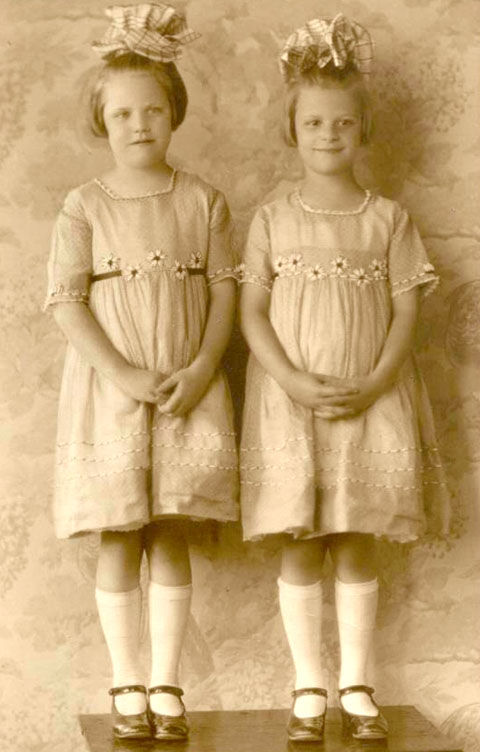
As the Phillips family became settled in Bartlesville, their life broadened beyond business. Their son John grew up surrounded by the activity of a booming oil town, and in time Frank and Jane opened their hearts and home to two orphaned sisters. They adopted the girls and gave them the names Mary Francis Phillips and Sara Jane Phillips. The sisters were raised as part of the family and shared fully in the life of both the Bartlesville home and the country retreat that would come to define the family’s later years.
By 1916 the Phillips brothers considered leaving the ups and downs of oil to start a chain of banks in Kansas City. That plan changed when the United States entered the First World War and the demand for oil surged. The need for reliable petroleum products convinced Frank that oil was the future. On June 13, 1917, the brothers gathered their various holdings into one consolidated company, the Phillips Petroleum Company. The new corporation began with modest assets, twenty seven employees, and a strong determination to grow.
Under Frank’s leadership the company expanded rapidly. Phillips Petroleum invested in gas plants, refineries, and pipelines, transforming itself from a producer into a fully integrated operation.
In 1926 the company completed a major refinery at Borger, Texas, which became a cornerstone of its refining business. The Borger plant allowed Phillips to move from simply producing crude oil to manufacturing gasoline, lubricants, and other refined products on a large scale. It also gave the company the infrastructure it needed to enter the retail gasoline market.

The following year, in 1927, Phillips Petroleum opened its first branded service station in Wichita, Kansas. The company had been testing a new high octane gasoline that needed a name. During a test drive on U.S. Route 66, one of the cars reached a steady speed of sixty six miles per hour. The coincidence of the highway number, the car’s speed, and the gasoline’s specific gravity near point six six made an impression. The fuel was christened Phillips 66, and the distinctive shield logo based on the highway sign soon appeared across the country. The brand quickly became known for quality and reliability, and Phillips 66 service stations spread across the Midwest and beyond.
In 1925, during this period of expansion, Frank and Jane purchased land southwest of Bartlesville in the Osage Hills to create a private retreat they called Woolaroc, formed from the words woods, lakes, and rocks. The ranch grew into a vast property that served as both a working cattle operation and a wildlife preserve. Frank stocked it with bison, elk, and other animals and filled the lodge with Western art, Native American artifacts, and mementos from his travels. Woolaroc became both a personal refuge and a gathering place for guests, business associates, and friends from around the world.

Before Jane became ill, Frank had already chosen the place where he wanted them to rest when their lives were done. It was a gentle, south-facing slope above Elk Lake at Woolaroc, a peaceful hillside that overlooked the water he loved to fish. He never guessed that his plans would soon be needed. When Jane died in 1948, her loss shook him deeply, and his thoughts turned entirely to building a permanent resting place worthy of her. She was temporarily laid to rest in the White Rose Mausoleum in Bartlesville while Frank devoted himself to the design of a family tomb at Woolaroc.
He visited Will Rogers’s resting place in Claremore several times, studying its form and materials, and drew from it a quiet inspiration. He wanted something smaller, more natural, and less imposing, but solid enough to endure for generations. Within months construction began on the slope above the lake, and Frank came out almost every day to watch. Many mornings he sat silently in his car by the sandstone bridge, looking on as the workers cut and blasted into the rock. The mausoleum became his focus during that long season of mourning.

He insisted that it be built of uncut native Woolaroc sandstone so it would appear to grow out of the landscape itself. The workers blasted into the rocky hill to shape the burial chamber, roughly twenty-four feet square. The tomb was designed to accommodate twelve interments, though only three would ever be used. Jane, Frank, and their son John are the sole occupants.

The interior was built with the same attention to detail that Frank gave to everything he touched. The walls were eighteen inches thick with a waterproof barrier and equipped with heating and cooling to protect the structure from moisture. The interior forms a circular rotunda beneath a domed ceiling supported by eight ten-foot columns of Italian marble. Several colors of marble were imported for the floors and benches, arranged in a pattern featuring an eight-pointed star at the center.
The walls are covered with thousands of small hand-set Italian mosaic tiles in deep reds and maroons that catch the light in subtle tones. Two bronze doors with decorative scrollwork separate the chamber from the entryway, and beyond them stand massive outer doors of solid bronze set into the sandstone façade.

Above the entrance, the family name is carved simply into the stone. A small terrace extends in front, bordered by stone railings and centered by a circular fountain whose water sparkles in the sunlight.
When the building was finished about a year later, Jane was brought home to Woolaroc. A quiet family service marked her return, and those who were there said Frank seemed calmer that day than he had been since her death. The mausoleum looked out over Elk Lake, the water where he had spent many peaceful hours fishing, and it gave him comfort to know she rested in the place they had loved most.
Frank served as president of Phillips Petroleum until 1939 and then as chairman of the board until his retirement in 1949. Through the Depression and World War II he guided the company with a careful balance of ambition and caution, maintaining jobs and production while expanding into aviation fuel and other petroleum products essential to the war effort.

Jane’s passing left him deeply lonely, and his health declined afterward, though he remained interested in the company’s progress and in the care of Woolaroc, which by then had become both a home and a public treasure. In the summer of 1950 he traveled to Atlantic City, New Jersey, for a period of rest. There, on August 23, 1950, he died at the age of seventy six. His body was brought home to Oklahoma and laid beside Jane in the mausoleum at Woolaroc.
Their son John Gibson Phillips died of a heart attack on the cruise ship Queen Mary, his body was returned to Oklahoma and placed in the Phillips Mausoleum with his parents.
Mary Frances married Marcus Low in 1935, they remained happily married until Mary's death in 1997. They had 2 children, Marcus Jr. & Frank Phillips Low. Mary & Marcus are buried in Davenport Memorial Park, Davenport, Iowa.
Sarah Jane married Frank Begrisch in 1937, They moved to Rye, Ny. they remained happily married until Frank's death in 1974, Sarah lived until 2003. They had 2 daughters Jane & Mary. Sarah & Frank are entombed in the Begrisch Mausoleum at Woodlawn Cemetery, Bronx, New York.
Frank Phillips Ranch - Woolaroc

The story of Woolaroc began in 1925 when Frank and Jane Phillips purchased several thousand acres of rugged Osage Hills land southwest of Bartlesville. What started as a small country retreat soon grew into one of the most remarkable private ranches in the American Southwest. Frank chose the name Woolaroc from three simple words that described the place he loved most woods, lakes, and rocks. It was a landscape of rolling hills, sandstone ridges, quiet waters, and open sky, and it became his refuge from the noise of business life in Bartlesville.
At first Woolaroc was little more than a weekend retreat. Frank built a modest lodge overlooking Elk Lake, stocked the surrounding land with native and exotic wildlife, and created a comfortable but unpretentious escape for family and guests. The lodge became a gathering place for business associates, friends, and visiting dignitaries who came to relax, hunt, and talk by the great stone fireplace. Jane often joined him there, welcoming guests with warmth and grace. The ranch reflected both of them—Frank’s love of the land and Jane’s sense of hospitality.
The first animals at Woolaroc were native species, but Frank’s interests soon widened. He introduced bison, elk, and deer, and over time the ranch became home to species from other continents as well, including zebra, water buffalo, and ostrich. At its height, the preserve covered thousands of acres and supported one of the most diverse private collections of wildlife in the country. For Frank, it was both a conservation effort and a personal joy. He saw the ranch as a way to preserve a glimpse of the natural world that was rapidly disappearing from Oklahoma.

Inside the lodge, the walls began to fill with paintings, sculptures, and relics of the Old West. Frank collected art from some of the best-known Western painters of his day, along with Native American artifacts, saddles, firearms, and other pieces of frontier history. He had a deep respect for the cultures that had lived on the land before him and wanted Woolaroc to reflect that story as well as his own. Guests who visited were often astonished to find a rustic ranch house filled with fine art and rare collections.
In 1927, the same year the first Phillips 66 station opened in Wichita, Frank sponsored an airplane in the Dole Air Race from California to Hawaii. The plane, named Woolaroc after his ranch, won the dangerous trans-Pacific competition and became a symbol of daring and endurance. After its victory, the plane was brought home and displayed in a small pavilion on the ranch. That building became the starting point for what would later grow into the Woolaroc Museum.

During the 1930s, as the oil business matured and the Great Depression set in, Woolaroc became a haven not just for the Phillips family but also for the company’s employees. Frank often hosted gatherings for his workers and their families, believing that the beauty of the ranch should be shared. The grounds were used for picnics, company events, and philanthropic functions, reinforcing his image as a generous and approachable leader.
After Jane’s death in 1948 and Frank’s in 1950, Woolaroc continued to be maintained by the Phillips family and by the foundation Frank had established to preserve it. His will ensured that the property would remain intact, protected, and open for the public to enjoy. In the years that followed, the ranch evolved from a private estate into one of Oklahoma’s most cherished historical and cultural sites.
The Woolaroc Museum expanded steadily, adding to the art and artifact collections Frank had begun. Today it holds one of the finest Western art collections in the country, with works by Frederic Remington, Charles Russell, Thomas Moran, and many others. Its Native American exhibits include pottery, beadwork, clothing, and ceremonial items that trace the history of the region’s tribes. The museum’s galleries tell the story of the American frontier, the oil era, and the unique vision of the man who created the place.

The ranch itself remains a working wildlife preserve, home to hundreds of animals that roam freely over rolling hills and open pastures. Visitors can still see herds of bison grazing along the roads and elk drinking at the lakes, just as Frank intended. The original lodge, restored to its early appearance, still stands with its stone walls, heavy beams, and quiet views across Elk Lake.

Woolaroc is more than a museum or a ranch. It is a living piece of Oklahoma’s history, shaped by one man’s imagination and preserved by the generations who followed him. What began as a private retreat for Frank and Jane Phillips has become a public treasure, visited by thousands each year who come to walk its trails, view its collections, and experience the spirit of the land. The same woods, lakes, and rocks that inspired its name continue to define its beauty and timelessness.
Phillips 66
Over the following decades after Frank's death the company continued to expand refining capacity, retail service station presence, and downstream marketing across the United States. The brand was well known and service stations carrying the Phillips 66 shield became part of the roadway landscape. The company entered new markets, adjusted operations through the mid-20th century, and became a mature integrated oil business with upstream, midstream, and downstream components.
In 2002 the company merged with Conoco to form ConocoPhillips, combining large scale exploration, production and downstream assets. Ten years later, on May 1, 2012, the downstream operations of ConocoPhillips were spun off into an independent entity, which adopted the name Phillips 66. This new Phillips 66 inherited the refining, marketing, transportation, and chemicals businesses, and began trading publicly under the ticker symbol PSX.
Since the spin-off the company has focused on refining, pipelines, natural gas liquids, and chemicals, while maintaining the legacy retail fuel brands such as Phillips 66, Conoco, and 76. It has grown globally, added new infrastructure, invested in petrochemicals, and developed midstream capabilities to move feedstocks and products across the United States and internationally. Recent years have seen the company acquiring pipeline and fractionation assets, strengthening its natural gas liquids position in regions such as the Permian Basin and the Gulf Coast, and consolidating refining interests to create economies of scale and integrated value chains.
Today Phillips 66 remains headquartered in Houston, Texas, and operates a network of refineries, pipelines, fractionation and chemical facilities, and marketing brands in many countries. While the oil industry faces transition pressures, the company is adapting by investing in petrochemicals, natural gas liquids, renewable fuels and infrastructure to support changing energy demand. The brand that began in rural Oklahoma nearly a century ago continues to be visible at service stations, in refineries and pipelines, and as a corporate presence in global energy markets.
Thank you Woolaroc Museum for all of the wonderful photos. Please visit woolaroc.org


Comments