


Rosecliff & The Legacy of Tessie Oelrichs

Updated: Nov 19, 2025

Rosecliff stands on the cliffs of Newport, set back on a broad lawn that descends to the Atlantic. The house did not evolve over generations and it did not come from inherited architectural taste. It was conceived with a clear purpose by one person. That person was Theresa Alice Fair Oelrichs, known in society as Tessie. She selected the site, chose the architect, directed the plan, determined the scale, and understood the role the house would play in Newport.

Tessie Fair was born in Virginia City, Nevada, on June 30, 1871. Her father, James Graham Fair, left Ireland for the American West and rose from hard rock mining to controlling interest in the Comstock Lode, the richest silver strike in the United States. The Fair family became wealthy at great speed, and their wealth was discussed in newspapers across the country. When Tessie was still young, her parents’ marriage ended in a public and bitter divorce. Her mother, Theresa Rooney Fair, received what was then the largest financial settlement in American history and retained custody of her daughters. Tessie and her younger sister, Virginia, were raised between San Francisco winters and Newport summers, where the structure and expectations of East Coast society were observed closely.
In 1890 Tessie married Hermann Oelrichs, the American representative for the North German Lloyd Steamship Line. The marriage placed her in prominent social circles in New York and Newport. Her father did not attend the wedding but later transferred to her a substantial financial gift. With part of that money, Tessie and Hermann purchased the marble residence of Mary Mason Jones on Fifth Avenue. It served as their principal winter address. Newport, however, required a separate and distinct architectural identity.

The land chosen for that identity had once belonged to the historian George Bancroft. Tessie and her sister acquired the property in 1891. In 1898 she commissioned the firm of McKim, Mead and White. Stanford White directed the design, and Jules Allard and Sons executed the interior decoration. Construction began in 1899. The house was built of brick and clad entirely in white architectural terracotta. The choice of material ensured that the house would read as a single, unified form when seen from the lawn or from the sea.
The central element of Rosecliff is the ballroom. It measures approximately forty by eighty feet and occupies the entire center of the house. All circulation is arranged around it. The stair hall opens toward the terraces and lawn. The dining room and billiard room occupy the north wing. Service spaces are located on the floor below and are connected to the principal rooms by lifts and back stairs so that staff movement would not interrupt formal events. Rosecliff was planned as a house for entertaining rather than private domestic life.
Tessie took residence at Rosecliff in July 1900 while work was still underway. In August of that season she held a dinner for more than one hundred guests. Flowers and greenery were used to screen unfinished portions of the ballroom. Completion followed in 1902. The house had already taken its place in the Newport summer season.

The most widely recalled entertainment at Rosecliff during Tessie’s lifetime took place on August 19, 1904, during the week of the Astor Cup yacht races. The event became known as the Bal Blanc. Decorations and attire were white and silver. Guests moved through the stair hall, ballroom, and terraces in a planned sequence. Photography was not permitted and no known images of the event survive. Contemporary newspaper descriptions remain the primary record.
Tessie and Hermann lived increasingly separate lives. He spent extended periods in San Francisco and Baltimore attending to business and political matters. She remained in New York and Newport, maintaining the social houses there. In September 1906 Hermann died at sea while returning from Europe aboard the Kaiser Wilhelm der Grosse. When his will was opened, it left the greater part of his estate to his brother, Charles May Oelrichs, on the grounds that Tessie possessed an independent fortune. Tessie contested the will, arguing that as the widow of a California citizen she was legally entitled to a share of his property. The dispute was resolved by compromise. Reports at the time recorded that she received one hundred thousand dollars in bonds, her son received a ranch valued at fifty thousand dollars, and further claims were withdrawn. The settlement also closed an accounting related to Hermann’s earlier trusteeship of certain Fair family holdings.

The result of the compromise allowed Tessie to continue maintaining Rosecliff as her principal Newport residence. In the years that followed, she oversaw the house with precision. She maintained a structured household routine. She carried out daily inspections of rooms and grounds. She continued to host and receive through the summer seasons. Rosecliff served as her center of life. Tessie died at the house on November 22, 1926. She was buried at Woodlawn Cemetery in the Bronx.
After her death, Rosecliff passed to her son, Hermann Oelrichs Jr, and his wife, Dorothy. In 1941 the contents of the house were sold at auction, and the property itself was sold soon after.
It was purchased for twenty one thousand dollars by Anita Niesen for her daughter, the actress Gertrude Niesen. During the winter of 1941 to 1942 the house was left unheated and without a caretaker. The pipes froze and burst, and water flooded the rooms and hallways. As temperatures dropped, the water froze again, forming thick sheets of ice across floors and staircases. The damage was extensive. The house was sold in 1942 to Ray Alan Van Clief. He repaired and refurnished the interiors and acquired the neighboring property By the Sea to enlarge the grounds. He was killed in an automobile accident before taking full residence, and his widow sold the property.

In 1947 Rosecliff was purchased by John Edgar Monroe and his wife, Louise, of New Orleans. They used the house as a summer residence for more than twenty years. Because the original furnishings had been dispersed in 1941, many of the furnishings associated with Rosecliff today date from the Monroe period. In 1971 the Monroes donated Rosecliff, its contents, and a sustaining financial endowment to the Preservation Society of Newport County.
Rosecliff is now open to the public as a historic house museum.


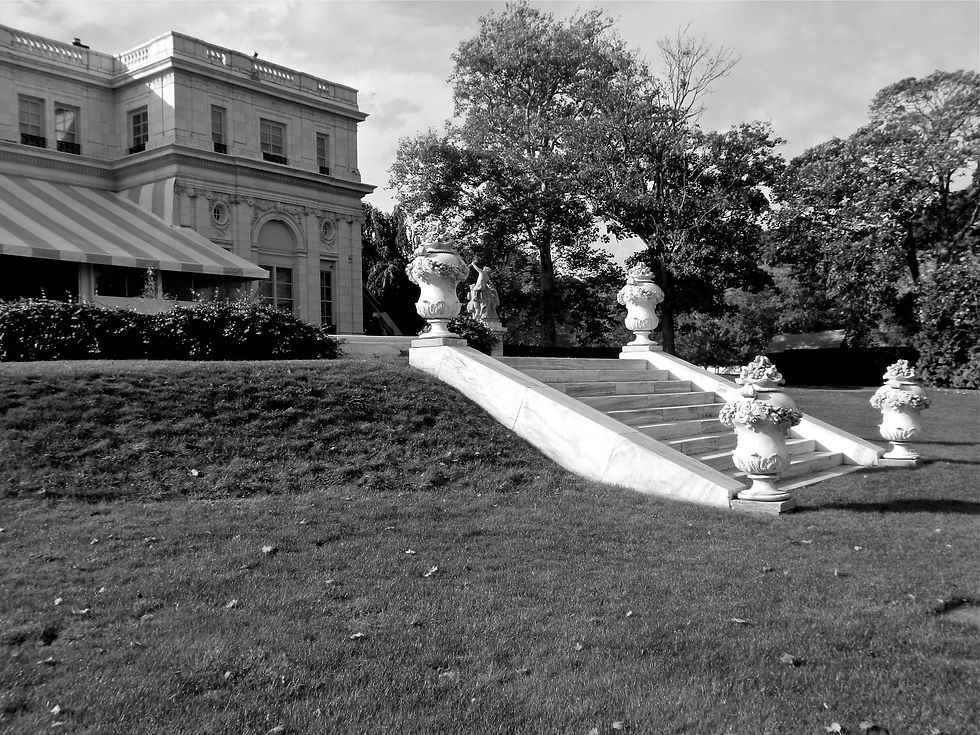


Photographed by Matthew J. Niewenhouse, Others from Oldlongisland.com & the McKim, Mead, & White Archives.


Comments