


The Legacy of John and Mable Ringling


John Ringling was born Johann Nicholas Rüngeling on May 31, 1866, in McGregor, Iowa, into a family that understood work long before it understood wealth.

His father, August, was a harness maker, and the family later settled in Baraboo, Wisconsin, where the Ringling children grew up in a household shaped by labor, necessity, and persistence. There was no indication in those early years that one of them would one day control the largest circus enterprise in the United States, build a palace on Sarasota Bay, and assemble one of the most significant art collections in Florida.
The Ringling brothers entered entertainment not as magnates, but as strivers.

In 1882, they presented a small traveling show, and by 1884 they had formed their circus and taken it on the road. In those early years, the operation moved by wagon, advancing town to town, dependent on weather, terrain, and uncertain audiences. The work was constant. Canvas had to be raised and lowered, animals fed and managed, equipment transported, tickets sold, and crowds gathered. It was a system that required discipline and coordination long before it required spectacle.
John distinguished himself early in the business. While others focused on performance, he focused on structure. He studied transportation, contracts, and logistics. By the late nineteenth century, the Ringling circus transitioned from wagon travel to rail, a change that transformed its scale. The circus became a coordinated system that moved by train, carrying performers, animals, tents, wagons, and equipment across the country. It operated as a traveling city, arriving, assembling, performing, dismantling, and departing with precision.
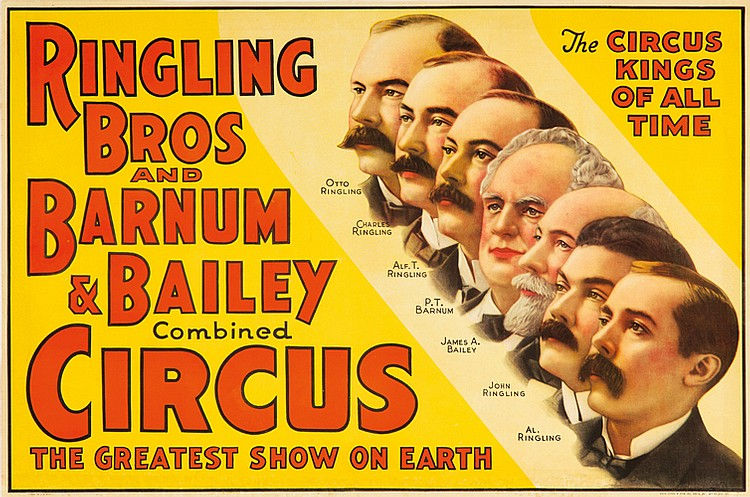
By the turn of the century, the Ringlings had become one of the largest circus organizations in the nation. In 1907, they purchased Barnum & Bailey, their greatest rival, for $400,000. For several years the shows operated separately, but after the 1918 season they were combined into a single enterprise. In 1919, the unified Ringling Bros. and Barnum & Bailey Circus opened at Madison Square Garden in New York, marking a defining moment in American entertainment. Through consolidation, expansion, and careful management, John Ringling helped create a system that dominated the traveling circus industry.
At the same time, his business interests extended beyond the circus. He invested in railroads, oil, land, and corporate ventures, including railroad enterprises in Oklahoma and elsewhere, and became involved in banking and major business institutions. Towns bore his name. His influence moved beyond performance into infrastructure, development, and finance.

In Chicago, John met Mable Burton, born March 14, 1875, in Ohio, the daughter of George Wesley Burton and Mary Elizabeth Wilson Burton. She had worked in a factory before leaving Ohio for Chicago, where she entered a different social and economic world. She was not born into wealth, but she developed a disciplined sense of taste and a strong personal vision that would shape everything that followed.
They married on December 29, 1905, in Hoboken, New Jersey. Their marriage marked a shift in John’s life. He had built wealth. With Mable, that wealth took form. Together they traveled extensively in Europe, where they studied architecture, collected art, and developed an aesthetic grounded in historical forms and decorative richness. Venice became a particular point of inspiration for Mable, whose interest in its architecture and design would later define their home.

By 1909, John and Mable were spending time in Sarasota, Florida, a coastal community still in development. In 1911, they purchased a waterfront estate at Shell Beach along Sarasota Bay. The property included an earlier residence known as Palms Elysian, built in 1895, where they lived for more than a decade before constructing their new home. During these years, Sarasota became more than a retreat. It became a project.
John invested heavily in the region. He acquired land across the barrier islands, including St. Armands Key, Bird Key, and large portions of Longboat Key. He financed and built the first bridge and causeway connecting the mainland to the keys, later donating it to the city. He was involved in hotel development, including the Hotel Sarasota and the El Vernona, and participated in shaping the physical and economic growth of Sarasota. He also relocated the winter quarters of the Ringling Bros. and Barnum & Bailey Circus to Sarasota in 1927, further tying the city to his enterprise.
El Vernona Hotel An aerial view of the unfinished Ritz-Carlton Hotel at the southern end of Longboat Key (1952).
While John worked on development and business expansion, Mable’s vision moved toward architecture and design. Through years of travel, she developed a clear idea of the environment she wanted to create. By the early 1920s, John and Mable decided to replace their existing residence with a new house that would reflect their experiences and ambitions.
They hired Dwight James Baum, a New York architect who had established himself designing revival-style residences and had received the Gold Medal of the Architectural League of New York in 1923. Baum first visited Florida in 1922 and began working for the Ringlings two years later. His work in Sarasota extended beyond Ca’ d’Zan to include civic and residential projects, but this commission would become his most recognized.

Baum was supported on site by architects Earl Purdy and Ralph Twitchell. Twitchell would later become a central figure in Sarasota architecture, establishing his own practice and contributing to what became known as the Sarasota School of Architecture. Construction of the house was overseen by Owen Burns, a contractor and developer deeply involved in Sarasota’s growth. Burns had paved streets, built subdivisions, established a bank, and constructed infrastructure, including causeways. His partnership with Ringling extended beyond this single project.
Construction of Ca’ d’Zan began in 1924. Over the next two years, the structure rose along Sarasota Bay. The design drew from multiple European influences, including Venetian Gothic, Italian Renaissance, Moorish, and Spanish forms, unified within a Mediterranean Revival framework. The house was named Ca’ d’Zan, meaning “House of John” in Venetian dialect, though its design and execution reflected Mable’s direction.
The exterior was constructed using polychrome terra cotta produced by O. W. Ketcham Terra Cotta Works in Pennsylvania, giving the façade its color and ornamental depth. Arched windows, decorative tracery, and layered surfaces reflected the architectural influences Mable had studied. The house extended along the bay with a broad terrace, integrating the building with the waterfront.

Inside, the house contained fifty-six rooms arranged for both living and entertainment. The first floor included reception rooms, a lounge, breakfast room, dining room, Great Hall, and ballroom. The interiors were shaped through the work of multiple artists and craftsmen. Willy Pogany, a Hungarian-born artist, designed and painted a series of murals for the ballroom ceiling known as “Dancers of the Different Nations,” as well as a Venetian Carnival scene in the third-floor playroom that included images of John and Mable and their pets. Decorative painter Robert Webb Jr. contributed painted ornament throughout the house, including floral and Venetian-style designs in major rooms.
Mable oversaw the selection of furnishings and decorative elements, sourcing items through European travel and estate auctions. She favored Venetian styles and specific color palettes, including shades of green. The house was not simply furnished. It was assembled through deliberate selection. Mable also shaped the landscape, developing the rose garden and influencing the placement of trees and sculpture. She chose to have her room face the garden rather than Sarasota Bay, a personal decision that reflected her priorities within the larger setting. The house was also designed to accommodate their animals, with interior gates allowing pets to move through certain spaces while being restricted from others.
By 1926, Ca’ d’Zan was complete.
In 1927, it was featured in Country Life magazine as “A Venetian Palace in Florida,” bringing national attention to the house.
At the same time, John and Mable were establishing the John and Mable Ringling Museum of Art. John had begun collecting art seriously in the 1920s, acquiring hundreds of works, particularly European paintings with a focus on Baroque art. The museum was designed to house this collection and to serve as a public institution. It opened in 1930, fulfilling their intention to create a cultural center in Sarasota.
In 1927, John also relocated the winter quarters of the circus to Sarasota, allowing the public to observe rehearsals and preparations during the off-season. This further integrated the circus with the city.
This period represented the height of the Ringlings’ achievements. The circus dominated its industry. Sarasota was developing under John’s influence. Ca’ d’Zan stood completed. The museum housed a significant collection.

On June 8, 1929, Mable Ringling died in New York City at the age of fifty-four. Her death removed the central creative force behind Ca’ d’Zan and the aesthetic direction of their work. She was placed in a receiving vault at Brookside Cemetery in Englewood, New Jersey. Plans had been drawn for a mausoleum under the Statue of David, in the courtyard of the art museum.

That same year, the stock market crash began a financial collapse that deeply affected John Ringling. His investments were heavily leveraged, and the economic downturn led to significant losses. In 1929, he had acquired the American Circus Corporation, expanding his control of the circus industry, but the timing contributed to his financial difficulties.

In 1930, John married Emily Christine Haag Buck, a divorcee, in Jersey City. The marriage occurred during a period of financial and personal decline. By 1932, he had lost control of his circus operations. Financial pressure mounted, including loans secured against his holdings, and control of assets shifted away from him.

John Ringling died on December 2, 1936, in New York City. He was placed beside Mable in the receiving vault at Brookside Cemetery. At the time of his death, he left Ca’ d’Zan, the museum, and his art collection to the State of Florida.
Following his death, the estate became the subject of legal disputes involving family members, creditors, and the state. The transfer of the museum and estate to Florida was delayed for approximately a decade. During this time, Ca’ d’Zan remained unoccupied, and the museum was not fully maintained. In 1946, the state assumed control, and a 1947 court ruling affirmed Florida’s claim to the estate, ensuring that the museum, house, and collection remained intact as a public institution.
Meanwhile, the remains of John and Mable were moved multiple times over the following decades. In 1954, they were transferred from Brookside Cemetery to Hackensack Cemetery in New Jersey. In 1958, they were moved again to Fairview Mausoleum in New Jersey. Attempts to bring them to Sarasota in 1960 and 1970 were unsuccessful due to disputes. In 1987, their remains were moved to Restlawn Memorial Gardens in Port Charlotte, Florida. Legal and administrative steps continued, and in 1990, approval was granted for their burial at the museum.

On June 4, 1991, John and Mable Ringling & John's sister Ida were interred at the Ringling Museum grounds in Sarasota.
Over the following decades, the estate underwent restoration and expansion. Ca’ d’Zan required ongoing preservation due to environmental exposure. A major restoration from 1996 to 2002 addressed structural and material issues. Additional restoration projects continued into the twenty-first century, including work on windows, masonry, and the reflecting pool. The museum campus expanded under state and university stewardship, adding galleries, educational facilities, and specialized collections, including circus-related exhibitions.
Hurricanes and environmental conditions continued to impact the estate, requiring ongoing conservation efforts. Despite these challenges, the Ringling remains an active cultural institution, housing art collections, historic structures, and educational programs.
Ca’ d’Zan still stands on Sarasota Bay, its design reflecting the architectural vision developed by John and Mable Ringling. The museum continues to display the collection they assembled. The city of Sarasota retains the imprint of John Ringling’s development efforts.
After decades of movement, legal conflict, and preservation, John and Mable Ringling came to rest within the estate they created, completing a journey that began far from Florida and ended at the edge of Sarasota Bay.
Photos: Historical photos of Ca' d'Zan, The Ringling Museum, and other historical documents are courtesy of The Ringling & Florida Memory. Other photos courtesy of Google Images, and my own private collection.


Another amazing and informative article of which I knew nothing about! Thank you Bobbie, love reading these!! Thanks
Fascinating!
Wow, this is so well composed! Excellent job on how the timeline details are laid out. I never knew there was such a back story. Very informative! 🫂💜
This is absolutely beautifully written. Loved every detail and the pictures are amazing. Well done Bobby!